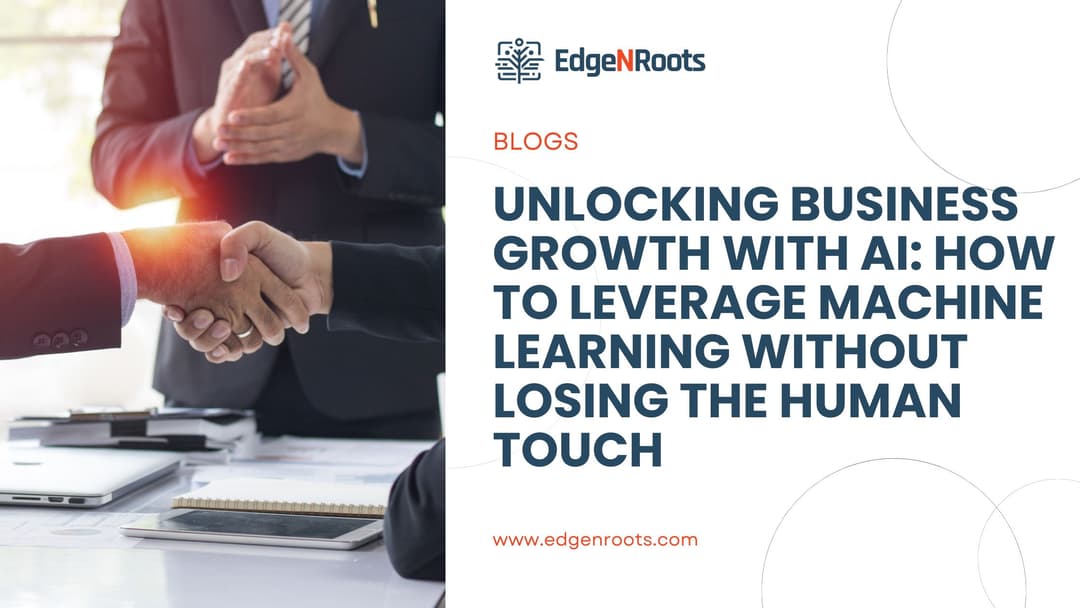
Introduction: The Promise and Peril of AI in Business Growth
Artificial intelligence is no longer a futuristic concept—it’s here, revolutionizing businesses across industries. From automating processes to delivering personalized customer experiences, AI is reshaping the way organizations operate, scale, and compete in an increasingly digital landscape. Companies that leverage AI effectively gain a significant advantage, optimizing efficiency, improving decision-making, and unlocking new revenue streams.
However, with great power comes great responsibility. While AI offers unprecedented opportunities, an over-reliance on automation can erode the very essence of what makes businesses successful—human connection. The personal touch that fosters customer trust, loyalty, and brand differentiation is often compromised when companies prioritize cost-cutting and scalability over genuine engagement. Embrace the future of business with Edgenroots—where AI meets human expertise to drive innovation and growth. Don’t just adapt; lead the change by leveraging machine learning without losing the human touch. Start your AI-powered transformation today!
The challenge is clear: How can businesses harness AI’s power without losing the human element that drives meaningful relationships and innovation? The answer lies in striking the right balance between automation and human intuition. Businesses must deploy AI strategically—enhancing operations while preserving empathy, creativity, and authenticity.
In this blog, we’ll explore practical strategies for integrating AI without alienating customers or stifling innovation. From customer support to decision-making and marketing, you’ll learn how to make AI work for you—without losing the personal touch that makes your business stand out.
Why AI Is Revolutionizing Business Growth
The Benefits of AI in Business
AI is transforming business operations, offering unparalleled efficiency and strategic advantages. One of its most significant benefits is automation—AI-powered tools can handle repetitive tasks, reducing operational costs and freeing employees to focus on high-value work. AI also accelerates decision-making by analyzing vast amounts of data in real time, allowing businesses to anticipate market trends, optimize supply chains, and respond to customer needs more effectively.
Moreover, AI enhances customer experiences by delivering hyper-personalized interactions. Predictive analytics enable businesses to understand consumer behavior, tailor marketing campaigns, and offer product recommendations that feel custom-made. AI-driven chatbots and virtual assistants provide instant support, improving response times and customer satisfaction.
In competitive markets, real-time analytics and predictive modeling give businesses an edge. AI identifies patterns and insights that humans might overlook, helping leaders make data-driven decisions. Companies using AI-powered forecasting and risk assessment can minimize uncertainties and adapt faster to changing conditions.
The Risks of Over-Automation
Despite its advantages, AI comes with risks—especially when businesses rely too heavily on automation. Over-automation can depersonalize customer interactions, making support feel robotic rather than empathetic. While chatbots and AI-driven systems can handle routine queries, they often struggle with complex or emotionally sensitive issues, leading to frustration and customer dissatisfaction.
Internally, an overemphasis on AI can reduce employee engagement. If workers feel replaced rather than empowered by AI, morale and creativity suffer. Human intuition and emotional intelligence—key drivers of innovation—can be lost when decisions are left entirely to algorithms.
Furthermore, AI lacks the contextual awareness and ethical considerations that humans bring to decision-making. Relying solely on AI-generated insights without human validation can lead to misinterpretations, biases, and flawed strategies. Businesses must recognize these limitations and maintain a balance between technological efficiency and human oversight.
5 Strategies to Leverage AI Without Losing the Human Touch
1. Enhance Customer Support with AI—But Keep Human Oversight
Problem:
AI-powered chatbots have become a game-changer in customer service, efficiently managing routine inquiries. However, they often falter when faced with complex issues requiring emotional intelligence, context, or creative problem-solving. Many companies implement AI-driven customer service only to find that customers become frustrated when their concerns aren’t fully addressed.
Signs:
- High volumes of simple queries being handled by AI, but an increasing number of escalations to human agents.
- Customer complaints about receiving generic or unhelpful responses from chatbots.
- Declining customer satisfaction scores despite faster response times.
How to Fix It:
AI should complement—not replace—human customer support. The key is to establish a seamless transition between AI and human agents.
- Implement a hybrid model: Use AI chatbots for handling common inquiries while ensuring that complex or emotionally charged cases are escalated to a live representative.
- Train employees on AI analytics: Customer service teams should analyze chatbot data to identify recurring issues and refine responses for better engagement.
- Personalize AI-driven interactions: AI should recognize when a customer needs a human touch and proactively route them to a human agent before frustration builds.
By combining AI efficiency with human empathy, businesses can improve response times while maintaining the trust and satisfaction that customers value.
2. Use Predictive Analytics for Smarter Decision-Making While Valuing Human Insight
Problem:
AI-powered predictive analytics can process vast amounts of data and generate actionable insights. However, relying exclusively on AI-generated recommendations can lead to decisions that overlook contextual nuances. AI lacks the ability to interpret human emotions, cultural shifts, and real-time market dynamics the way humans do. Businesses that place full trust in automated reports without human validation risk making decisions that feel disconnected from reality.
Signs:
- Overdependence on AI-generated reports without manual verification.
- Lack of human input in interpreting business trends, leading to unexpected missteps.
- Decision-making that prioritizes AI-driven data over real-world experience and market intuition.
How to Fix It:
- Blend AI analytics with human expertise: AI should serve as a tool to enhance decision-making, not replace it. Businesses should encourage experts to analyze AI-generated insights critically before taking action.
- Create a hybrid decision-making framework: This involves integrating data-driven insights with strategic human judgment to refine strategies.
- Encourage cross-functional collaboration: Teams should regularly discuss AI-generated insights in the context of customer feedback, market trends, and human intuition.
By combining AI’s analytical power with human wisdom, businesses can make well-rounded decisions that are both data-driven and contextually aware.
3. Automate Routine Tasks to Free Up Time for Creative and Strategic Work
Problem:
Employees often spend excessive time on repetitive administrative tasks, leaving little room for creativity and strategic thinking. While these tasks are necessary, they do not add significant value to business growth and innovation. Over time, manual processes can lead to employee burnout, reduced productivity, and missed opportunities for innovation.
Signs:
- Employees are overwhelmed with data entry, scheduling, and reporting.
- A noticeable decline in creative output due to time-consuming administrative work.
- Low engagement levels, as employees feel stuck in repetitive tasks with no room for growth.
How to Fix It:
- Deploy AI-powered automation tools: Use AI to handle repetitive tasks such as customer follow-ups, inventory management, and workflow automation.
- Implement robotic process automation (RPA): RPA can streamline back-office operations, freeing employees to focus on high-impact work.
- Shift employee focus to innovation: The time saved through automation should be reinvested in strategic initiatives, brainstorming sessions, and problem-solving projects.
Automation should not be seen as a way to replace employees, but rather as a tool to empower them by reducing mundane tasks and unlocking their creative potential.
4. Integrate AI into Marketing for Personalization Without Losing Authenticity
Problem:
AI-driven marketing automation enables businesses to segment audiences, personalize content, and optimize campaigns at scale. However, over-automation can make marketing feel robotic and impersonal. If AI-generated content lacks human creativity, it can alienate customers rather than engage them.
Signs:
- Generic email blasts and mass messages that fail to connect with audiences.
- Declining engagement rates despite heavy investment in AI-driven marketing tools.
- Overreliance on automation, leading to a loss of brand voice and authenticity.
How to Fix It:
- Leverage AI for segmentation, but keep storytelling human: AI can identify customer preferences, but human marketers should craft personalized, emotionally resonant messages.
- Use AI-driven insights to enhance—not replace—creative marketing strategies: AI should help refine content recommendations, while humans bring creativity and authenticity to messaging.
- Strike a balance between automation and human touch: Automated marketing should be complemented with real human interaction, such as personalized follow-ups, community engagement, and brand storytelling.
When AI is used as a support tool rather than a substitute for human creativity, marketing remains engaging, relevant, and authentic.
5. Cultivate a Culture of Continuous Learning and Adaptation
Problem:
As AI continues to evolve, businesses must ensure that employees keep up with new technologies. Without proper training and adaptation strategies, AI integration can lead to confusion, frustration, and resistance. Employees who don’t understand AI’s role in their workflow may struggle with adoption, leading to inefficiencies.
Signs:
- Low adoption rates of new AI tools due to lack of training.
- Employee frustration with automated processes and reluctance to use AI-powered solutions.
- Decreased productivity as workers struggle to adapt to new technology.
How to Fix It:
- Invest in AI training programs: Conduct regular workshops, webinars, and hands-on training sessions to help employees understand how AI enhances their roles.
- Encourage a growth mindset: Foster a company culture that embraces continuous learning and adaptation.
- Establish AI champions within teams: Designate tech-savvy employees as internal AI advocates who can assist colleagues in adapting to new tools.
Businesses that prioritize AI literacy among their workforce will experience smoother adoption and maximize the value of AI investments.
How to Implement a Balanced AI Strategy in Your Business
1. Conduct a Technology Audit and Identify Gaps
Before implementing AI, businesses should assess their current tools, workflows, and technological gaps. A thorough audit will reveal areas where AI can bring the most value without compromising human oversight. Key considerations include:
- Identifying repetitive tasks that can be automated.
- Analyzing current decision-making processes to determine where AI can enhance accuracy.
- Evaluating AI readiness among employees and pinpointing training needs.
2. Develop a Roadmap for AI Integration
A structured approach is essential to successful AI adoption. Businesses should:
- Start with pilot projects: Implement AI in small, controlled settings before scaling.
- Set clear KPIs: Establish benchmarks for efficiency, cost savings, and customer satisfaction.
- Plan for employee training: Ensure that staff members receive adequate training to maximize AI’s potential.
3. Establish Feedback Loops and Monitor Performance
AI implementation should be an ongoing process that evolves based on feedback and performance metrics. Businesses should:
- Regularly review AI’s effectiveness in different areas.
- Gather feedback from employees and customers to refine AI applications.
- Ensure AI and human expertise work in tandem for continuous improvement.
By maintaining a balanced approach, businesses can maximize AI’s benefits while mitigating risks.
Conclusion: Embrace AI, But Don’t Lose Your Human Edge
AI is a game-changer in business, offering unmatched efficiency, accuracy, and scalability. However, over-automation can strip away the personal touch that builds lasting customer relationships, fosters innovation, and differentiates businesses from competitors.
The most successful companies will be those that use AI strategically—automating routine tasks while ensuring that human insight drives decision-making, customer engagement, and creativity. AI should enhance, not replace, the human experience.
Now is the time to take action. Invest in AI wisely—automate the routine, empower your team with insights, and always keep the human element at the heart of your business strategy. Unlock growth and stay competitive by striking the perfect balance today.