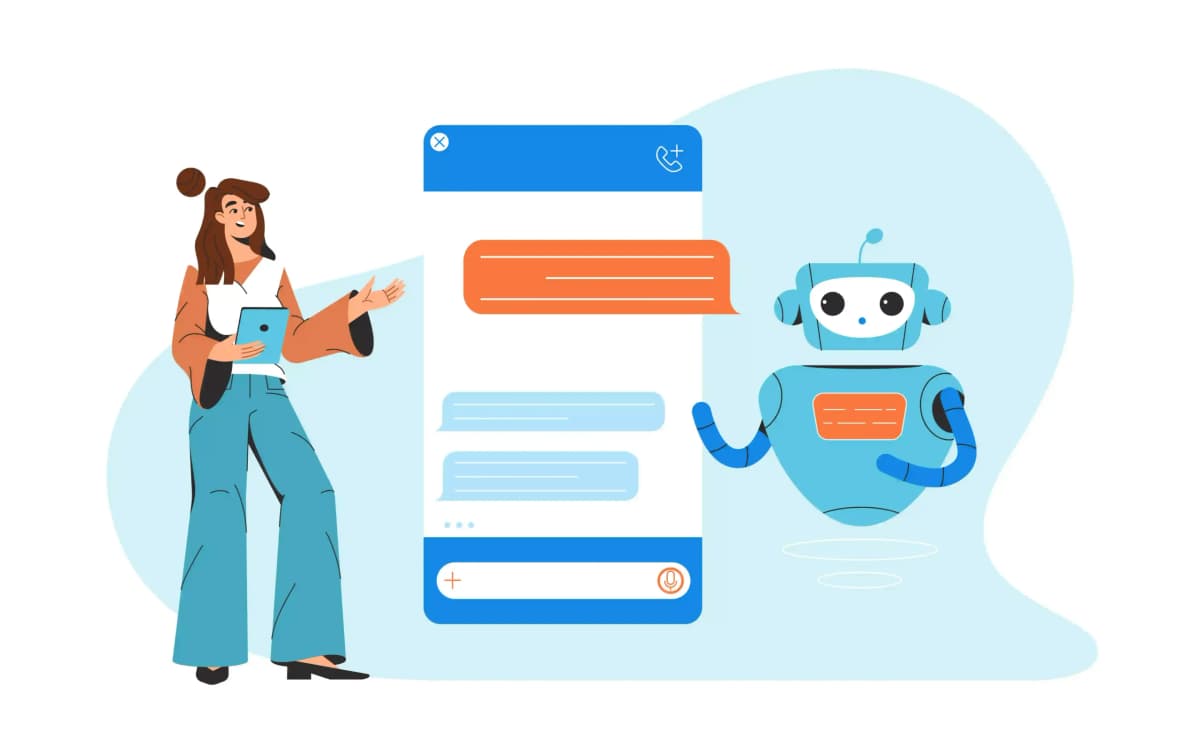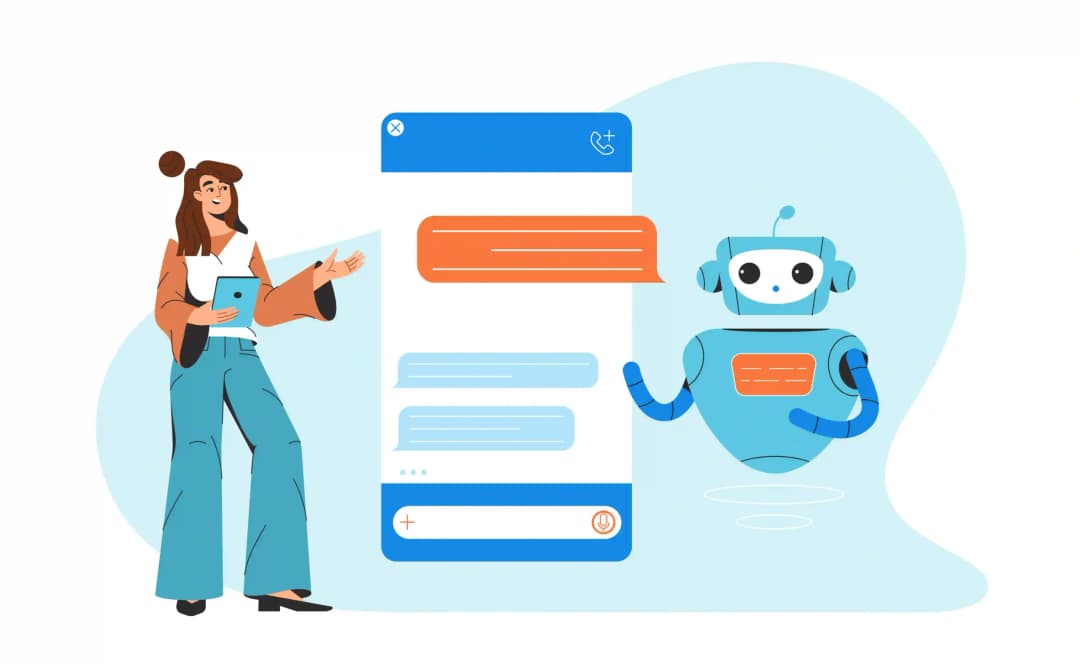
Almost every business asking about AI right now is asking the wrong first question. The question is not “should we get AI?” It is “which kind of AI actually solves the problem we have?”
That distinction matters, because the two things most vendors sell under the same banner are not the same product. One answers questions. The other does work. Getting the choice wrong costs you either a bloated build you did not need, or a cheap tool that quietly frustrates your customers for eighteen months.
This guide breaks down AI chatbot vs AI agent for business in plain language: what each one is, what each one can and cannot do, what they cost, and a short decision framework you can run in ten minutes before you ever speak to a vendor.
The Short Answer
An AI chatbot talks. An AI agent acts.
A chatbot lives inside a conversation. You ask, it responds, and the interaction ends when the window closes. Its output is language.
An AI agent uses conversation as one input among many. It can plan a sequence of steps, call your systems, take actions inside them, check whether the action worked, and adjust course if it did not. Its output is a completed task.
If your problem is “customers keep asking the same forty questions,” you want a chatbot. If your problem is “our team spends nine hours a week moving data between three tools,” you want an agent.
Most of the confusion in the market comes from vendors selling the first while using the vocabulary of the second.
What Is an AI Chatbot?
An AI chatbot is a conversational interface, usually powered by a large language model, that responds to user messages based on a defined knowledge source.
Modern business chatbots are considerably better than the rigid button trees of five years ago. A good one will:
- Answer questions using your product docs, FAQs, policies, and pricing pages
- Understand messy phrasing, typos, and follow up questions
- Handle multiple languages
- Capture a lead by collecting a name, email, and requirement
- Escalate cleanly to a human when it is out of depth
- Run on your website, WhatsApp, Instagram, or in app
What a chatbot fundamentally does not do is change the state of your business. It will happily tell a customer that their order ships in three days. It will not go into your order management system, verify that, apply a discount, and email a revised invoice.
Typical business use cases: customer support deflection, lead qualification on landing pages, appointment enquiries, product discovery, internal HR and policy queries.
What Is an AI Agent?
An AI agent is a system that receives a goal rather than a question, then works out and executes the steps required to reach it.
The core difference is autonomy over a sequence. An agent has four capabilities a chatbot lacks:
Planning. Given “reconcile this month’s invoices against payments received,” it breaks the goal into steps rather than waiting to be told each one.
Tool access. It connects to your CRM, ERP, database, email, payment gateway, or calendar through APIs, and can read from and write to them.
Memory. It retains context across a long task and often across sessions, so step nine still knows what happened in step two.
Self correction. If an API returns an error or a record is missing, it recognises the failure and tries an alternative path instead of returning a confident wrong answer.
Typical business use cases: invoice processing, lead enrichment and routing, order status resolution end to end, inventory reordering, report generation from live data, onboarding workflows, multi step ticket resolution.
AI Chatbot vs AI Agent for Business: Side by Side
| Factor | AI Chatbot | AI Agent |
| Core output | A response | A completed task |
| Trigger | User message | Goal, event, or schedule |
| Works across systems | Rarely, read only at best | Yes, reads and writes |
| Memory | Usually within one session | Persistent across the task |
| Handles multi step work | No | Yes |
| Recovers from errors | No, it just answers | Yes, it retries or reroutes |
| Typical build time | 2 to 5 weeks | 8 to 16 weeks |
| Typical cost band | Low | Medium to high |
| Governance needed | Light | Significant |
| Best for | Volume of repetitive questions | Volume of repetitive work |
Five Differences That Actually Affect Your Numbers
1. What gets automated
A chatbot automates answering. An agent automates doing. If the expensive part of your process is a person clicking through screens rather than a person typing replies, a chatbot saves you very little.
Run this test on any process you are considering: if you removed the conversation entirely, would there still be work left? If yes, you need an agent.
2. Integration depth
A chatbot can be live in a fortnight because it mostly needs content, not access. An agent needs credentials, API endpoints, permissions, and a sandbox to test in. Businesses consistently underestimate this. The model is rarely the bottleneck. Your systems are.
If your data sits in spreadsheets, a legacy desktop application, or a CRM with no usable API, budget for the plumbing before you budget for the intelligence.
3. The failure mode
When a chatbot fails, it gives a wrong or unhelpful answer. Annoying, recoverable, visible.
When an agent fails, it may have already updated a record, sent an email, or issued a refund. That is a different category of risk and it is why agents need approval gates, action logs, role based permissions, and a defined rollback path. Any vendor who does not raise this with you has not built one before.
4. Cost structure
Chatbots are cheap to build and cheap to run, because one query is one model call.
Agents cost more on both counts. A single agent task may involve dozens of model calls plus API usage. The return justifies it when the work being replaced is expensive, but you should model cost per completed task, not cost per message, before you sign anything.
5. Organisational readiness
A chatbot needs someone to own the content. An agent needs someone to own the process. That means documented rules, clear exception handling, and a named person accountable for what the agent is permitted to do. If nobody in your business can describe the workflow precisely, an agent will simply automate your existing confusion at speed.
When a Chatbot Is the Right Choice
Choose a chatbot when most of these are true:
- Your inbound volume is high and repetitive
- Most queries are answerable from existing documentation
- Your goal is faster response times and lead capture
- You need to be live this quarter, not next year
- Your systems have limited or no API access
- Budget is constrained and you want a fast, provable win
A well built chatbot handling 60 to 70 percent of routine queries frees your team for the conversations that actually convert. That is a solid outcome and often the right first step.
When an AI Agent Is the Right Choice
Choose an agent when most of these are true:
- The bottleneck is manual work, not manual replies
- The same process runs many times a day with predictable rules
- Staff copy data between systems as a routine part of their job
- Delays or errors in that process cost real money
- Your core tools expose APIs
- You have someone who can define and own the workflow
The clearest signal is a process a competent new hire could learn in a week and then find boring for the next three years. That is agent territory.
When You Need Both, and How They Fit Together
In practice the strongest deployments combine the two. The chatbot is the front door. The agent is the operations team behind it.
A customer messages on WhatsApp asking where their order is. The chatbot understands intent and identifies the customer. It hands off to an agent, which queries the order system, checks the courier API, finds a three day delay, applies your standard goodwill credit, updates the CRM, and returns a specific answer. The chatbot delivers that answer in natural language and asks if anything else is needed.
The customer experienced one conversation. Behind it, two different systems did two different jobs.
This layered pattern is why you should not treat the choice as permanent. Start with the layer that solves the most painful problem now, and design so the second layer can be added without rebuilding the first.
Budget, Timeline, and Realistic ROI
Chatbot. Two to five weeks to deploy. Costs are dominated by content preparation and channel integration. Returns show up as reduced first response time, lower support headcount pressure, and more qualified leads reaching sales. Most businesses can measure impact within a month.
AI agent. Eight to sixteen weeks for a first production workflow, including discovery, integration, testing, and a supervised pilot. Costs are dominated by integration engineering and governance, not by the AI itself. Returns show up as recovered staff hours, fewer errors, and faster cycle times. Expect to measure impact across a quarter.
A note on ROI claims: be sceptical of any percentage quoted without a baseline. Before either project starts, record how long the process takes today, how often it goes wrong, and what that costs. Without that number you will never be able to prove the investment worked.
Common Mistakes to Avoid
Buying an agent to solve a content problem. If your customers are confused because your documentation is poor, no amount of autonomy fixes that.
Buying a chatbot to solve a workflow problem. It will answer beautifully and change nothing operationally.
Giving an agent write access on day one. Run it in suggest mode first. Let it propose actions a human approves. Expand permissions once accuracy is proven.
Skipping the audit trail. You need to know what the agent did, when, and why. This is not optional in regulated or finance adjacent workflows.
Treating it as a one off project. Both systems need ongoing tuning as your products, policies, and processes change. Budget for maintenance from the start.
Decide in Ten Minutes
Answer these five questions honestly:
- Is the repetitive thing in my business answering or doing?
- Can the ideal outcome be delivered as text alone, or does a system need to change?
- Do my core tools have APIs my team can access?
- Can I write the workflow down as clear steps with named exceptions?
- What is the cost today of doing this manually?
Mostly “answering” plus text only outcomes points to a chatbot. Mostly “doing” plus system changes plus documented steps points to an agent. Unclear answers to question four mean the first project is process mapping, not AI.
Frequently Asked Questions
Is an AI agent just a smarter chatbot? No. The difference is architectural, not a matter of degree. An agent has tool access, planning, persistent memory, and error recovery. A chatbot generates language. Adding a better model to a chatbot does not turn it into an agent.
Can we start with a chatbot and upgrade later? Yes, and it is often the sensible path. Insist that the build uses a clean knowledge layer and documented integration points so the agent layer can be added on top rather than replacing everything.
How much human oversight does an AI agent need? Heavy during the pilot, light once accuracy is proven. The realistic model is a human approving actions early on, then reviewing exceptions and audit logs once the agent is trusted with a defined scope.
Do we need clean data first? For a chatbot, you need accurate content. For an agent, you need reliable data and stable APIs. Messy underlying data is the most common reason agent projects stall, so audit it before you commit.
Which one gives faster return on investment? A chatbot returns value faster in absolute time. An agent usually returns more value in total, because it replaces labour rather than deflecting messages. The right question is which problem is costing you more right now.
Where EdgeNRoots Fits
We build both, and we are fairly direct about which one you actually need.
EdgeNRoots develops custom AI products, CRM platforms, and business automation for companies across India, Canada, and the UAE. Our ENR Accelerator platform provides ready modules for leads, customers, invoicing, approvals, tasks, reporting, and analytics, which means an agent has real systems to act on from day one rather than waiting on months of foundational build.
As an official Meta Business Partner with verified WhatsApp Business API access, we deploy conversational layers on the channel your customers already use.
Start with a free audit. We will map your workflows, identify where the cost actually sits, and tell you plainly whether you need a chatbot, an agent, or better process documentation before either.
Request a free audit | Explore Our AI | See the EDGE Ecosystem